
In May 2024 my husband asked me if I could paint a prize box for our friend, Lord Aleksandr Tomasovic, who was fighting his prize fight to advance to rank of Free Scholar within the Academie d’Espee of Atlantia. This is the second box I’ve painted for this purpose.
This time, I chose to paint the box in a style that would match the recipient’s persona. In this case, Aleksandr has a Rus persona, so I chose a style with Russian origins – Mezen wood painting.
I’ll also admit to being a bit selfish here – I really love the look of Mezen folkart. Before I started this project I knew that finding documentation to support it’s existence pre-17th century would be challenging, but I went with this style anyway.
I did eventually find research dating the carving of nature and animal motifs in the Mezen region to the 12th century in Folklore and Folk Art of Russians of the European North (Dmitrieva, 1988, pg 114). The same book also describes how it was common for homes, especially on doors, doorframes, and window frames to be painted with similar symbolism, with historic examples from the 1800s. Based on this information, I find it plausible to extrapolate that this style of wood painting is older than the year 1600, but I was unable to find any documentation of early examples.
This lack of documentation could be for a number of reasons. One of which is that this style of painting was typically used to decorate domestic items of the non-ruling class. These items were typically not a priority for preservation or study. Another reason could be that this painting style was exclusively used on wooden mediums, which also makes pre-17th century preservation a challenge, especially in harsh climates and areas prone to fire. Lastly, we know that Socialist Realism became the only state-sanctioned art style for 60 years (starting in 1932), which led to the destruction of both religious and folk art styles across the Soviet Union (Rohotchenko, et al., 2022).
I also think it’s important to note that while we may not have any evidence of this painting style in period, the symbology used almost certainly goes back to ancient history. A notable example of this type of symbolism can be found in the reindeer depicted in the White Sea Petroglyphs. These petroglyphic reindeer share many stylistic features with the much later Mezen paintings and depict similar scenes.
For anyone interested in the symbology used in Mezen art, this is an interesting site to visit, though it is in Russian so it will need to be translated, but does include additional sources.

I didn’t take many progress pictures for this project, but the process was the same as the one used for this box.
In short:
- Sand the box smooth.
- Coat the entire box with gesso (serves as a basecoat).
- Depending on how bright you want the colors, coat the entire box with white acrylic after the gesso has dried.
- Go to town with your design!
- When finished, use a spray lacquer to protect the paint.
The finished box was presented at Hawkwood Baronial Birthday.


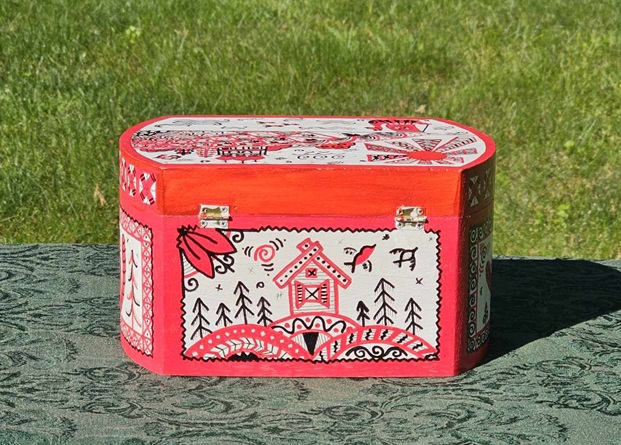

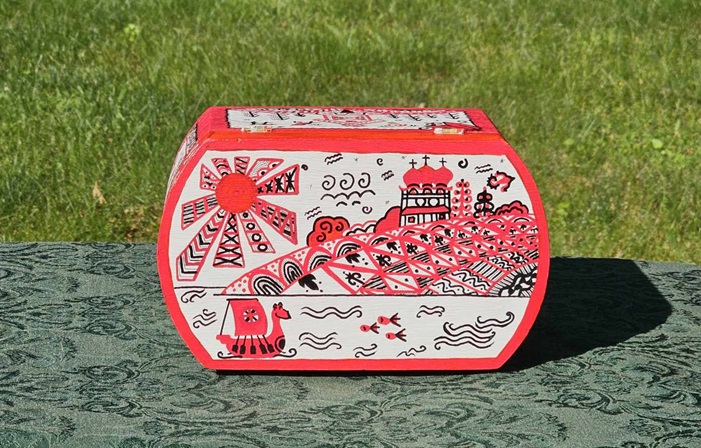

Because of the intricacy of this particular style of painting, I used a combination of regular acrylic paint and brushes, acrylic paint pens in various thicknesses, and sharpies.
Overall, I’m quite happy with how this project turned out. It was a fun way to try out a new art style and get a little creative!
References
Rohotchenko, et al. (2022). Socialist Realism: An Instrument of Class Struggle in Ukrainian Fine Arts and Architecture. https://philpapers.org/rec/ROHSRA-2
 Baroness Margaret Lad, OP
